You finish the workday, close your laptop, and finally sit down, but your mind is still answering emails.
Your shoulders remain tense. Your thoughts keep moving from one unfinished task to another. Even though the work has stopped, your body has not received the message that it is allowed to rest.
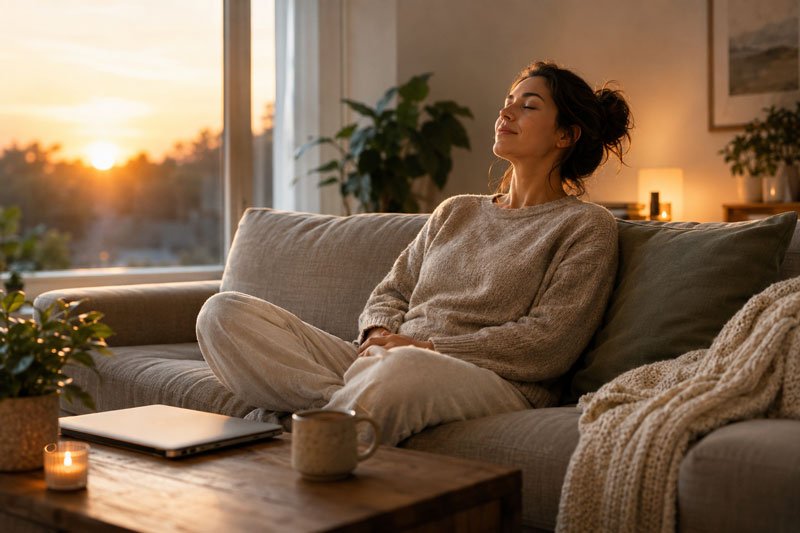
For many overworked adults, this experience becomes familiar. The body may be physically still while the mind continues planning, reviewing, anticipating, and problem-solving.
Guided relaxation offers a simple way to create a clearer transition between being constantly “on” and genuinely settling down.
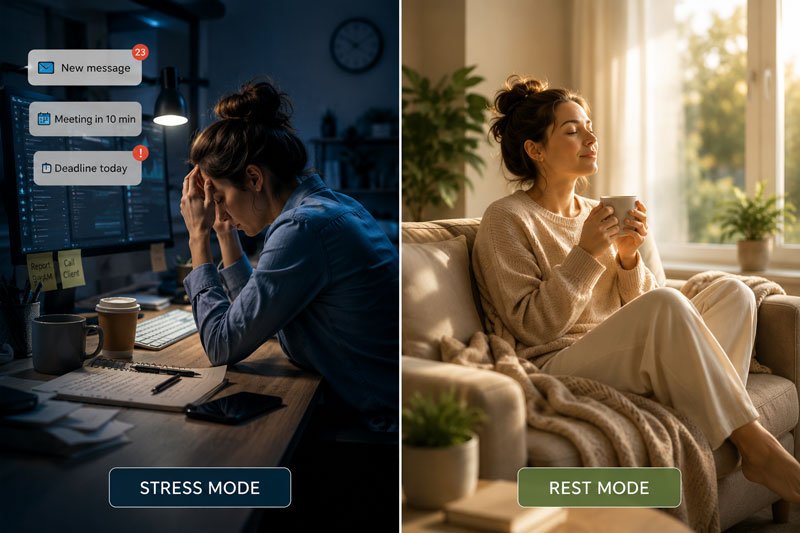
Stress is a normal human response to pressure, uncertainty, and demanding situations. When your brain detects a challenge, your body prepares to respond.
Your breathing may become faster. Your heart rate may increase. Your muscles may tighten, and your attention may narrow toward whatever seems most urgent. This is often described as the body’s stress response, or “fight-or-flight” response.
This response is useful when you need energy and concentration. The problem is not that your body experiences stress. The difficulty arises when demands continue for long periods without enough opportunities to recover.
Modern work can keep this response quietly active throughout the day. Deadlines, messages, video calls, decisions, notifications, noise, and constant switching between tasks can all add to a feeling of cognitive and sensory overload.
You may notice this as:
These experiences do not necessarily mean something is wrong with you. They may be signs that your mind and body have spent too much time responding and not enough time recovering.
Guided relaxation is a practice in which a calm voice leads your attention through breathing, bodily sensations, imagery, or the gradual release of tension.
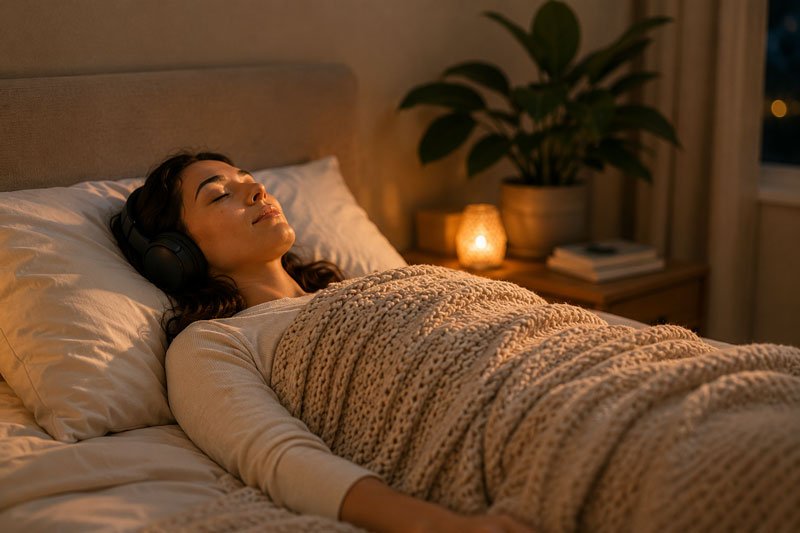
Instead of requiring you to figure out how to relax, the guidance gives your attention somewhere simple and predictable to rest.
A session may invite you to:
Relaxation techniques are intended to encourage what is known as the relaxation response, a state associated with slower breathing, a reduced heart rate, and lower blood pressure. It is often described as the counterpart to the body’s stress response.

After a demanding day, simply deciding to relax may not be enough. Your mind might understand that work is over while your body remains tense and alert.
A guided session creates a deliberate transition.
A slower voice, fewer sensory demands, comfortable physical support, and gentle breathing can help communicate that immediate action is no longer required.
The goal is not to force your nervous system into a particular state. It is to create conditions in which settling becomes easier.
Overwork is not only physical. It also creates mental congestion.
Throughout the day, your attention may be divided among messages, conversations, deadlines, screens, background noise, and unfinished tasks. Even during a break, your mind may continue processing these inputs.
Guided relaxation simplifies the environment of your attention. Instead of deciding what to think about next, you follow one gentle instruction at a time.
Notice your breath.
Feel the surface beneath you.
Allow your shoulders to become heavier.
This temporary reduction in demands can provide relief from cognitive overload.
Stress commonly affects the way we breathe. Breathing can become faster, shallower, or less comfortable without us consciously noticing.
Many guided relaxation practices invite slower, easier breathing. Research suggests that breathing practices may support parasympathetic activity, which helps counterbalance the heightened sympathetic activity associated with stress and anxiety.
This does not mean you need to take enormous breaths or follow a rigid pattern. For some people, trying too hard to control the breath can create more tension.
A gentler approach is often more comfortable:
Breathe in naturally.
Allow the exhale to leave without pushing.
Notice whether the next breath can be slightly softer.
During an intense workday, attention often moves upward and outward, toward screens, ideas, decisions, and other people’s needs.
You may not notice that your jaw is clenched, your forehead is tense, or your shoulders have been lifted for several hours.
Guided relaxation brings awareness back to physical sensation without demanding that you immediately fix anything.
Simply noticing pressure, warmth, heaviness, or tension can help you reconnect with the body you have been carrying through the day. This is one reason many relaxation sessions use language related to gravity and support. Feeling the chair, bed, or floor beneath you can reduce the sense that you must continue holding everything up by yourself.
One of the hardest parts of overwork is that it can follow you into the rest of your evening.
You may leave your desk but continue mentally rehearsing tomorrow. You may check messages while eating, scroll through more information, and then expect your mind to become quiet the moment you go to bed.
A brief guided relaxation can serve as a boundary between work and recovery.
It becomes a small ritual that says:
The active part of the day is ending.
Unfinished tasks can wait.
My attention is returning to the present. The Centers for Disease Control and Prevention includes deep breathing, meditation, breaks from constant information, and making time to unwind among healthy ways of coping with stress.
A common misconception is that relaxation requires complete mental silence.
It does not.

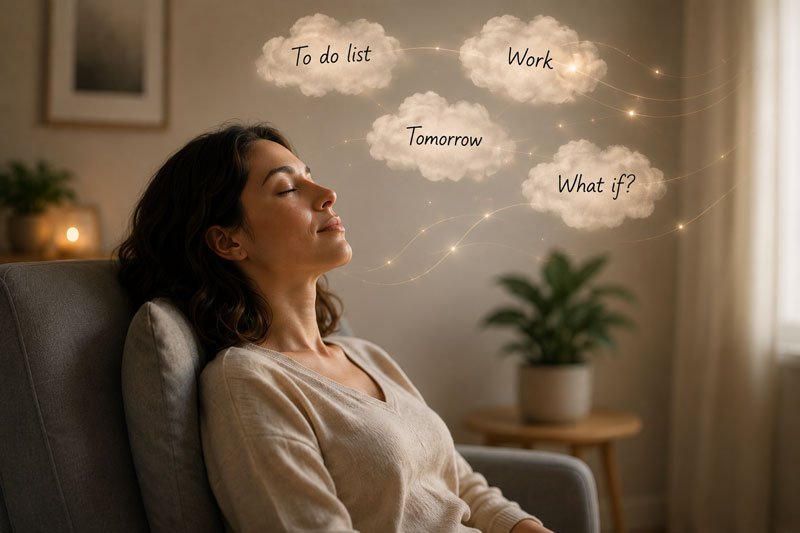
Thoughts may continue to appear during a guided session. You might remember something you forgot to do, mentally revisit a conversation, or notice that you are still restless.
The practice is not to prevent thoughts. It is to stop treating every thought as an instruction that requires an immediate response.
You can notice the thought and return to the voice.
You can remember the task and choose not to solve it yet.
You can feel tension without becoming frustrated that it is still present.
Relaxation is not a performance. There is no perfect state you need to achieve.

Choose a place where your body can feel supported. You may sit in a comfortable chair, lie on a bed, or rest on the floor with cushions.
Reduce unnecessary stimulation by lowering the lights, silencing notifications, and loosening restrictive clothing. Headphones can help you hear quieter details, but they are optional.
Most importantly, avoid turning the session into another task you need to complete correctly.
You do not have to breathe perfectly.
You do not have to relax every muscle.
You do not have to remain completely focused.
Let the guidance carry some of the effort for you.
Creating a calming environment can help signal to your body that it's time to shift out of stress mode. Dim the lights, silence notifications, and make yourself physically comfortable. Wrapping yourself in a soft blanket, sitting in your favorite chair, or lying down somewhere quiet can make your relaxation practice feel even more restorative.
If you're looking for something exceptionally soft, our Microfiber Blanket is designed to add warmth and comfort to your evening relaxation routine.
Deep recovery is supported by many factors, including sleep, manageable workloads, movement, nourishment, supportive relationships, and appropriate healthcare when needed.
A short guided relaxation cannot remove every source of stress. It is not a replacement for medical or mental-health care, and it cannot make an unsustainable workload sustainable by itself.
What it can offer is a meaningful interruption.
For six minutes, you are not required to produce, solve, respond, or prepare.
You are simply giving your nervous system fewer demands and your body a chance to soften.
That small pause may help you move into the rest of your day with a little less tension and a little more space.
When you are ready, find a comfortable position and begin Decompression and Deep Neurological Rest.
Let the voice guide you away from mental noise, through the weight and support of your body, and toward a quieter state of rest.
Nothing needs to be forced.
Nothing needs to be finished first.
For the next six minutes, you are allowed to pause.